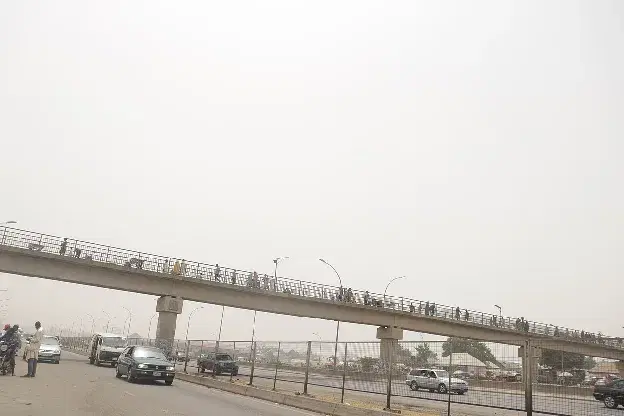
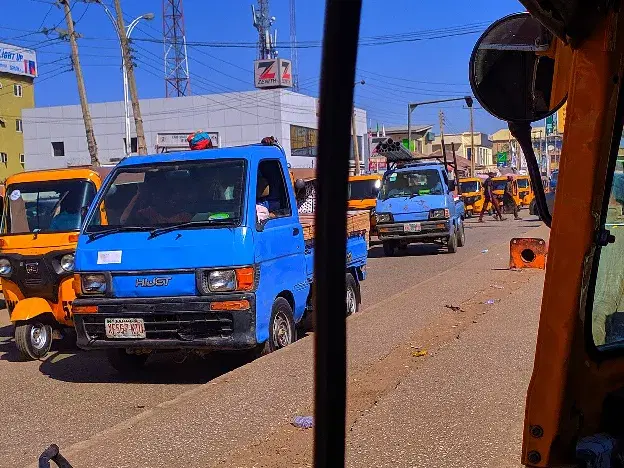
Nobody hands you a rulebook when you climb into an Abuja cab or bus. There's no sign on the window. No announcement. No orientation. But within thirty seconds of sitting down, you are expected to know exactly how this works.
Break a rule and you'll find out. Someone will hiss. The driver will glance at you the way a teacher looks at a child who came without a textbook. A stranger will explain your offence loudly, in the third person, to the entire vehicle.
So here it is, finally written down — the unofficial constitution of Abuja transport, as agreed by everyone who has ever stood at Berger, Area 1, AYA, Nyanya or Kubwa at 6:40 in the morning.
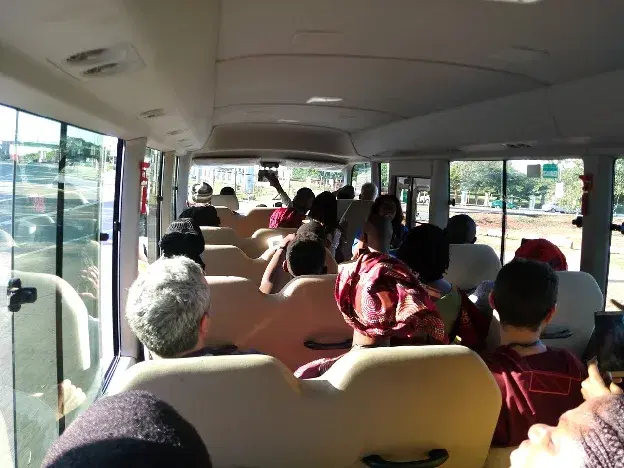
Four seats. Five people. A shared understanding nobody signed. Photo via Wikimedia Commons, CC BY-SA 4.0.
Rule 1: If you're big, buy two seats
This one is unwritten and universally enforced, and it's the one nobody wants to talk about honestly.
A row in an Abuja cab or bus is designed for four adults of assumed average size. That assumption is doing a lot of work. When a bigger passenger takes one seat, the two people beside them are absorbing the geometry, the shoulder that doesn't fold in, the arm that has nowhere to go, the sixty-minute leg cramp that arrives at Nyanya.
The rule that has emerged, quietly, is that you buy two. It's not a punishment; it's a peace treaty. You get to sit properly. Nobody spends an hour fighting for four centimetres. The fare on an Abuja intra-city cab is small enough that doubling it is manageable; the alternative is a bus-wide silent grudge you can feel on your skin.
The version of this rule that people don't say out loud: it also applies to bags. A big bag is a passenger. If your load takes a seat, the seat is a seat — or put it in the boot.
Rule 2: Have change, or ask for change before you sit
This is the rule that causes the actual fights.
Fares in Abuja are small and specific, a few hundred naira, occasionally rounding into four figures on the longer satellite-town runs. Notes are large and round. When you hand over a big note for a short trip, you have not paid. You have created a problem, and you have made it the driver's problem.
He will not accept it quietly. He'll announce your note to the vehicle. He'll ask if anyone can break it, in a tone suggesting you have personally sabotaged the morning. He'll hold your money until the very last second, sometimes until you're already standing on the road with your hand out.
There are two ways not to be that person:
- Break your money before you enter. Buy something. Anything. Sachet water counts.
- Ask for change before you sit. "Oga, you get change for ₦2,000?" — asked at the window, before your buttocks touch anything — is a completely different transaction than the same question asked at your drop-off point.
Cash still runs almost everything in Abuja, unlike Lagos, where LAMATA moved from 1 August 2026 to enforce cashless payment on regulated BRT and rail services — with commuters, not just drivers, now liable to prosecution for paying cash. The Cowry Card processed over 19 million trips in the first seven months of 2026 alone. Whether the FCT follows is an open question. Until it does, change remains your personal responsibility.
Rule 3: If you're the third person in a row of four, sit upright
This is the geometry rule, and it's the one that decides whether a forty-minute ride is bearable or awful for everyone in the row.
A row of four in an Abuja cab or minibus works only if each passenger occupies their assigned share of the bench. The third-in slot is the pivot — the person whose posture determines whether the row locks together cleanly or collapses into a shoulder-war.
If you're that third person: sit up. Shoulders squared. Arms folded inward. Do not lean, do not sprawl, do not put an elbow on the person beside you and settle in for a nap. The whole row is depending on you to hold the shape. Passengers 1 and 4 have a wall to lean against. Passenger 2 has already committed to the diagonal lean. You are the load-bearing seat. Act like it.
This rule is enforced in silence, but it is enforced. The person who slouches in the middle is the person other passengers remember by the time everyone gets down.
Rule 4: The last person in is the admin
The seat closest to the door is not a seat. It's a job.
You are now the door officer. You will open it. You will close it. You will step down at every stop so the person behind you can get out, then climb back in, then do it again two minutes later. You will collect fares from the passengers behind you and pass them forward. You will pass change backward and be held personally responsible if anything goes missing on the way.
If the driver forgets someone's stop, you'll be blamed for not calling it out.
Only take that seat if you're getting down soon, or if you have made peace with public service. If you're going far — CBD to Kubwa, Area 1 to Lugbe — negotiate your way further in and let someone else run the office.
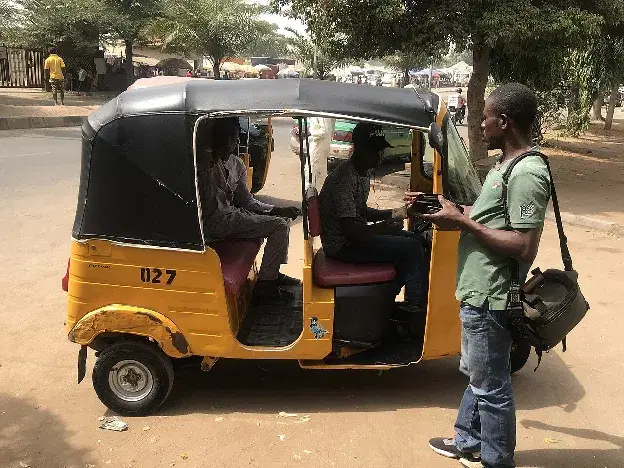
The fare transaction — still overwhelmingly cash, still overwhelmingly a negotiation. Photo via Wikimedia Commons, CC BY-SA 4.0.
Rule 5: Enter from the nearest bus stop, not from the road
This one is half about efficiency and half about staying alive.
An Abuja driver picking up mid-road, with no other passengers, in an area where nobody's watching, is a risk. "One chance" — the robbery pattern where criminals pose as drivers and passengers to prey on lone commuters — is one of the FCT's most persistent security problems. In 2026, the Nigeria Police Force detailed an 18-month investigation that took down a syndicate accused of robbing, kidnapping and extorting dozens of Abuja commuters. Security analysts have linked the surge directly to the transport shortage itself: when there aren't enough legitimate vehicles, stranded people at unlit spots become easy targets.
The bus stop — even the informal, unmarked one that everyone in your area calls "under the bridge" or "that tree" — is safer for a specific reason: it has witnesses. Other passengers waiting. Other drivers competing. Vehicles that stop there regularly, and are known to.
The rules that experienced Abuja commuters actually follow:
- Board from a proper bus stop where other people are already waiting.
- Never enter a cab that's already carrying passengers who seem oddly relaxed about picking you up.
- Get off your phone at the stop — police and security experts specifically flag phone distraction as what makes people targets.
- If it's late and the stop is empty, wait for the next vehicle rather than take the eager one.
- Sit where you can reach the door.
- Tell someone your route.
None of this is paranoia. It's the same instinct that makes you check for change before boarding, applied to something that matters more.
The FCT Administration is trying to formalise part of this. New terminals at Mabushi, Kugbo and the CBD came into operation in August 2026, and officials have ordered commercial operators off roadside loading points, framing the exercise partly as an anti-"one chance" measure. But three terminals do not cover a Kubwa-to-Wuse commute, and the small stops — lit, sheltered, marked — are what most commuters actually depend on.
Rule 6: If you're getting down soon, sit near the door. If you're going far, sit deeper in
This is the rule everyone eventually learns the hard way.
Board a bus for a two-stop trip and settle into the back row, and you'll be climbing over four people, apologising twice, and probably leaving a bag behind. Board for a Kubwa-to-Wuse run and sit in the door seat, and you'll spend the entire commute standing up every three minutes so someone else can get out.
The rule:
- Short trip? Enter last. Sit by an edge. Take the door seat if it's a cab — you're only going to be there ten minutes anyway, and the admin duties won't kill you.
- Long trip? Go deep. Take an inside seat, especially in a minibus where the front and back sections behave differently. The middle rows are the quietest part of the vehicle. Fewer people climbing over you, less traffic to the door, less disturbance every time someone gets down at an unexpected point.
This is also the rule that decides whether you get any sleep. On a Kubwa or Lugbe run, an interior seat is the difference between arriving at work rested and arriving having stood up eleven times.
Why any of this exists
Here's the honest observation underneath the jokes.
Every one of these rules exists because the system doesn't supply the structure. There's no posted fare, so you negotiate. There's no ticketing, so you must have cash change. There's no verified operator registry, so you assess a stranger's vehicle for danger in four seconds. There's no reliable schedule, so you join a scramble. There's no clear seat allocation, so a row of four has to negotiate itself into a shape.
Passengers wrote a constitution because nobody else did.
Abuja is currently attempting an answer at the top of the system — terminals, licensing, enforcement against illegal parks. If it works, some of these rules will quietly die. Nobody will miss the shoulder-war in the middle seat.
Until then: buy two if you need two, break your money before you board, sit upright if you're the third, choose your seat by the length of your trip, and never enter a vehicle from a lonely road when a real bus stop is nearby.
The rules aren't the problem. They're the workaround. And they've kept Abuja moving longer than any policy has.
Sources: National Bureau of Statistics Transport Fare Watch (May 2026) via Punch, Guardian NG and Nairametrics; Premium Times, HumAngle and The Whistler on "one chance" in Abuja and phone-distraction advisories; New National Star (2026) on transport pressure, evening hotspots and safety; TheCable, Daily Post, Voice of Nigeria and Peoples Gazette on FCTA terminals and enforcement (August 2026); Punch, Technext, Guardian NG and PM News on LAMATA cashless enforcement and Cowry Card volumes.